Music with a Message

Whether there are lyrics or not, every composition has a theme and an emotion or idea that the composer is trying to convey. Music perhaps is one of the strongest communicators for emotion. That’s why music is used as background for movies and TV shows. In fact, music is strong enough that it can completely change the emotions that are conveyed in a movie scene. There’s even a YouTube video that gives an example of this. Here’s a link to it. https://www.youtube.com/watch?v=rn9V0cN4NWs

I recently went to a classical concert with one of my Christian friends, Elizabeth, and I decided to just ask her some questions about how she views music. In case it interests you, here are just a few questions and responses below.

So what did you think of the classical concert?

It was pretty good. I mean, some of the songs were great. Some of the songs with the choir started to put me to sleep cause they all sounded the same. But I like how they ended with happy, peppy songs to leave us on a positive note.

Do you personally think all music has a message?

Definitely. I would say some music has stronger messages than others, but they all have messages. And usually it’s fairly obvious what those messages are too.

Do you think that, as a Christian, there are certain types of music you should avoid because of their messages?

I think so. Some music has better messages and emotions than others. I don’t think we should be listening to particularly negative music or music with lyrics that promote bad actions or habits. I definitely think Christians should be selective with their music knowing that what they listen to influences them and affects them.

So just remember, folks, what kinds of messages you’re giving through your compositions, and if that’s the message you really want to be sending. Have a great day!


Songwriting Tips

Just to avoid confusion, when I say songwriting, I’m basically referring to music with lyrics rather than musical compositions that rely solely on notes. That being said, songwriting is not something that I do often, simply because thinking of words to go with my compositions just doesn’t appeal to me; however, I thought these few tips would be helpful.

Tip #1: Use someone else’s words

If you’re simply horrible at making up lyrics, but really want to create a song with words, I suggest looking up some good poetry written by a famous poet like John Keats or Tennyson. Once you’ve learned to put words to music, making up your own lyrics later will come more naturally. It’s easier to create and practice if the words are already there for you.

Tip #2: Don’t get carried away

Make sure that your desire to compose a good song doesn’t overwhelm a good melody. Essentially, if you get carried away and start going crazy on the ornamentation and extra flourishes, you might pull away from the melody of the song, which also diminishes the lyrics. In fact, people might have trouble finding the melody. Obviously, you don’t want to create any composition where the melody is completely lost, but I’ve found particularly that when I’m attempting to songwrite, it’s hard to hit that spot where the melody and lyrics are being emphasized without making the song too simplistic.

Tip #3: Write out the lyrics

Okay, this might seem super obvious, but it’s something that I almost never do. I just figure I’ll somehow remember the lyrics I’m creating as I’m currently composing. Don’t do this! That is, don’t do it, unless you’re somehow really smart and can remember everything. Whenever you think of lyrics you like, jot them down, then continue. It will save you time and discouragement in the end. I also have a link to an article that actually gives some good ideas about writing just the lyrics of a song, so check it out!

https://www.dittomusic.com/blog/how-to-write-a-song-10-tips-on-how-to-boost-your-creative-side-when-writing-songs


by Monoar from Pixabay 🙂

Finding Your Own Style

Have you ever listened to a song and been able to say who composed it without even being told? Recently I made a blog post about developing new styles and learning new genres, and that’s a great thing to do! But if you don’t even know what style your own music compositions are, maybe that’s a bit rough. Music has come a long, long way since Bach was sitting on his bench, creating his very Baroque organ fugues. Now there’s so many genres of music that trying to figure out where your own style fits into those genres is a little overwhelming. It’s quite possible that you play a mixture of different genres. This post isn’t supposed to be super technical or necessarily, exact musical theory doctrine. So just for fun, how do you figure out what your style is?

Look at what you’ve grown up playing.

If you’ve grown up playing mainly classical music, the chances are that your style is going to be classical. But obviously there are different types of classical music. There’s romantic, baroque, modern, impressionist, and more that I can’t think of right now. And they all have very different sounds. Think baroque and you have some screechy harpsichord belting out keys in a rapid succession with consonant chord progressions. The rhythm is steady and it’s fairly emotionless. Then there’s impressionistic, where the song is all about mood and emotion. Chords can be dissonant and unpredictable, and the rhythm is quite changeable. So where do you go from there?

Look at how the pianists in your life compose.

Maybe you grew up playing classical music, but your style isn’t very similar to what you grew up playing. I’ve noticed that I often tend to play like my mom, who is also a pianist, because I’ve heard her play so many times that that style is integrated in my brain. Obviously, we’re not exactly alike, but there are similarities. I have a friend who plays almost exactly like his older brother. If you have a close relative who you’ve spent a lot of time listening to when they play, chances are some of that has rubbed off on you. Listen to them play and compare it to your own compositions and arrangements

Record yourself playing and then listen to the recording.

When you’re focused on composing and creating, you’re listening with a critical ear. But if you record your composition and stop and listen to it without criticism and get the mood for the piece, what do you hear? Do you hear stately piece with unrelentingly exact rhythm? A soft, flowing song? A really ornamented melody? Very basic chord progressions? It’s amazing how listening to your song from a recording rather than while you’re playing it can make such a difference in your perception of the song.

Remember that your style will probably not fit into one exact genre, and it can always change.

No two styles are alike and that’s what makes every person’s compositions so unique! Because there are so many different types of music, and we’re constantly being inundated with different genres, the chances that your style of composing is exactly like every baroque song by Bach is unlikely. Just like everyone has a different style with photography, writing, and drawing, so too is every person’s style in composing unique and special. Music genres are more of a spectrum than set genres, nowadays anyways, since genres are constantly being intertwined and pulled apart. The point of figuring out where on the spectrum your style lies is merely to help you better appreciate your own abilities no matter how bad or good they may be. Because someone will always be able to play better than you, but they’ll never be able to play quite like you. 😀

telegraph.co.uk

Creating a Melody

I wanted to show a certain YouTube video, made by 12tone, a YouTube account that talks about music. It’s a short, helpful video that explains a little bit about how to create a melody. I would have difficulty teaching how to create a melody simply because melody doesn’t have rules or steps like chord progressions do. It’s not as simple as giving you a list of chord progressions, but despite that, this video does a good job of explaining a few things about how melody works.

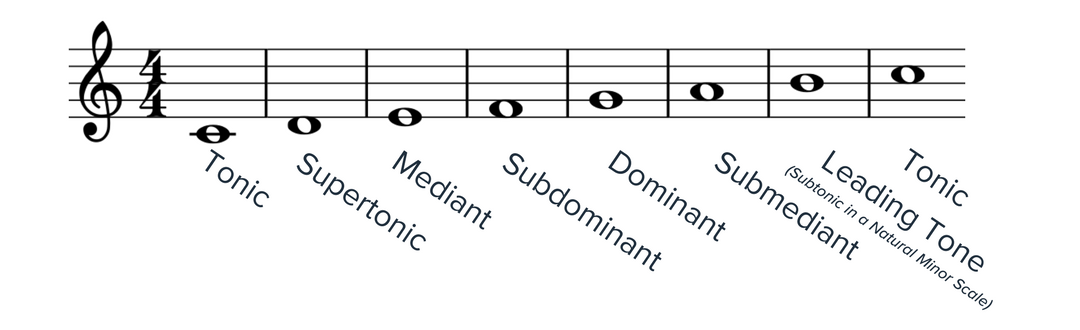
The video is a little bit technical so before you watch it, I just want to mention that when the narrator talks about moving to the fifth or second or sixth, he’s referring to scale degrees, which is just a numbering of scale. For instance, in the key of C, the note F would be the fourth scale degree, because it’s four notes from C. He also mentions leading tone, which is simply the seventh scale degree. You can see the scale degrees’ technical names in the picture below.

Musicnotes.com “Glossary of Musical Terms

Music Presentation

Hello!! Today I made a presentation about how to learn a new music genre. So if you’ve only ever composed in one genre and want to learn a new one, this is the video for you! I’m hoping it will be helpful for you guys. Sorry that the audio is a little bit grating. Obviously, my voice isn’t as melodious as I wish it were. Maybe I should add some background music. 😉

Musical Form

I just want to give a brief overview of some different musical forms, that is, how you can develop your songs. For example, a lot of songs in this era have a verse, chorus, verse, chorus sequence and sometimes, a bridge. Maybe you don’t want to follow that standard, or maybe you want to try something new or more simple. I’m going to give an overview of three other musical forms.

Theme and Variations

This form is fairly simple, but it does stretch you because it forces you to change up and explore your own compositions. Basically, the form is exactly what its name implies. You have your basic melody and chords, but you have to make them more interesting. Maybe you’ll add extra notes to enhance the melody, or change the way you’re playing your chord progressions. Typically you play the theme once, and then add two or three different variations then end the composition. I’ve never actually tried to compose a song using this form simply because it’s challenging, but I do plan on trying it soon. For more information on how to play using this method see this website: https://www.musictheoryacademy.com/understanding-music/theme-and-variations/

Ternary Form

This is a really simple form, but I think that’s a good thing, because it allows you to explore and have quite a bit of leeway. Ternary form is basically ABA form. Usually you have an A section (kind of your first melody and chord progressions) and then you have B section which is supposed to contrast with your A section a bit. For instance, if your A section is more happy sounding and playful, your B section might be a little more serious or sad. Or maybe your A section is really discordant and sounds kind of Postmodern, so you make your B section sound a bit more pleasant and romantic. After the B section, you go back to A section again, but typically this time the A section is a little bit more interesting or complex than the previous A section.

Adding a picture to make this page look a little more interesting and colorful 😉

Strophic Form

This form is simply A-A-A. I chose this form simply because if you’re first starting out creating music, maybe one melody is really all you can focus on right now. And that’s perfectly fine. That’s how my first song was. In this form, you have three A sections, and they all pretty much sound the same. If you want, you can make your third A section a little different or ornamented than the first two.

Different Forms

There are all different types of musical forms and plenty of information about them online. Feel free to check out on other websites other forms like Sonata, Binary, and Rondo forms and many more!

What To Do

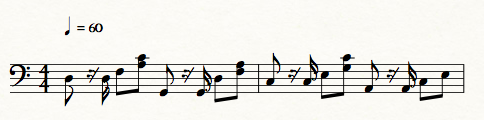
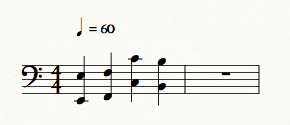
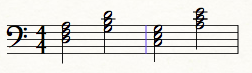
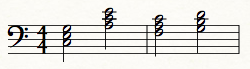
Maybe you’re thinking, “I have chord progressions, but now what do I do?” Sometimes, having a bunch of chord progressions jumbled around in your head isn’t going to help you. You need to know what to do with them. So I’ve made ten different examples of what you can do with chord progressions. If you want, you can just play exactly what I’ve written, but I feel like I need to warn you that a fair amount of my examples do not follow the prior two progressions I’ve showed you. It was just simpler for me to use whatever progressions came to my head, and it will also allow you to familiarize yourself with more progressions and what to do with them. Again, remember that you can use any chords or chord progressions with these. So let’s get started!

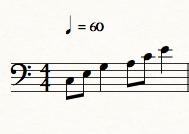
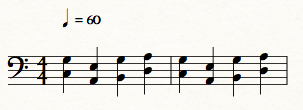
This is probably the simplest way to play chord progressions, so if you want to start simple, this is it.
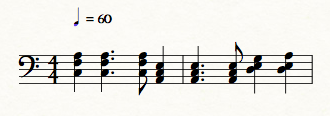
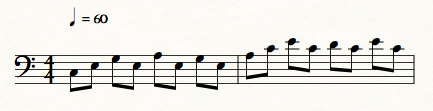
This one is also fairly simple, but more choppy than the other one
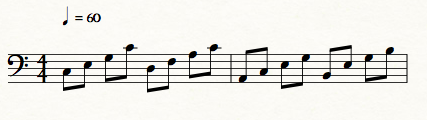
A little weird and basically just a more complex, and quick version of the last one.
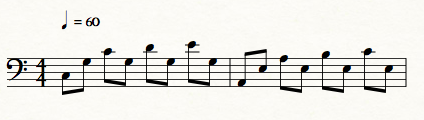
This one works really well if you want a slightly edgy, or intense song.
Again, here’s another really basic way to play a chord progression if you don’t feel like starting out with the less basic ones.
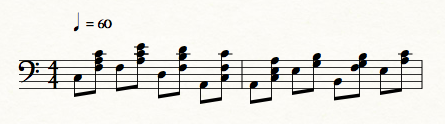
This structure makes a really pretty, flowing sound to a song.
Basically just unblocked chords.
Fairly similar to the last two, but it’s a little more interesting.
This one is pretty different from the other ones, and a lot more playful. I think it’s pretty fun.
And here is just the typical full octaves. Also, play this on the piano and it sounds kind of eerie. Oops.

Chord Progressions

Today, I want to talk about chord progressions, because they will be integral to your compositions. Sometimes, when I’m composing, I just like to try random chord progressions to see what works, but when someone’s first starting out, they’d probably appreciate to start with something a little more tried and true. So I’m going to teach two simple, but enjoyable chord progressions. My examples will be in C major, by the way. The first progression I’m going to start with is…

ii-V-I-vi

Or for those of us who can’t read Roman numerals: the 2-5-1-6 progression. It looks like a fairly simple progression and it is. This is a really fun progression to play, and, depending on how you play it, you can make a song sound happy, playful, or jazzy. This is a jazz chord progression (a really common jazz progression, I might add), but don’t worry! You can use it for a lot of other things, too. Sometimes, chord 6 is dropped and it just becomes the 2-5-1 progression, or some people play the 1-6-2-5 progression. Feel free to explore both!

I-vi-IV-V

This is the 1-6-4-5 progression, an extremely common progression used in all sorts of songs, along with its counterpart 1-5-6-4. Maybe I should be showing less common progressions, but I felt like this one was hard to pass over since it’s used so much. There’s a reason some progressions are overused: because they sound nice. Either that or we are all just very unoriginal these days. But I’ll make up for being unoriginal because…

How to Make Common Chord Progressions Interesting

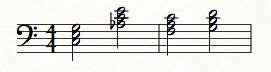
Sometimes, it’s just not enough to have chord progressions, especially when you have two really common, overused chord progressions, but there are ways to make these progressions a bit more interesting. First, try out flats, sharps, and sevenths. As an example, here’s a way to switch around the second chord progression I showed you and make it a little more fresh, because let’s be honest. We need some freshness!!!!!!

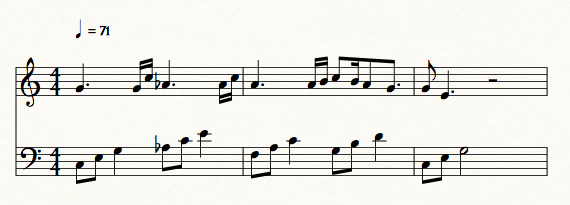
Try playing the 1-6-4-5 progression, then try playing the progression with the A flatted. Notice what a difference one flat can make. You might be wondering, “How on earth would I use this chord progression with this random flat?” As an example, at the bottom of this post, I have written a simple, short melody that works with this chord progression. Anyway, so the point is that you don’t have to stick with overused chord progressions. Don’t be afraid to try out flats or sharps! I’m adding a link to a helpful website that explains further and does a really good job explaining and teaching, so feel free to check it out!

How to Write Interesting Chord Progressions: Chromatic Alterations

Composing is for anyone!

This topic is something I need to discuss before we go any further. I think many people start out with the preconception that creating music is only for professionals, people with a degree in music, or someone who has spent decades playing an instrument. However, I want you to throw this preconception out the window. You don’t need to know the intricate workings of piano theory or be an advanced pianist to learn the skills of creating music on the piano. All you need are some basic piano knowledge and skills, hands (preferably two hands), and some fingers, preferably ten. If you have more than basic piano knowledge and skills and more than two hands or ten fingers, that’s great!

Don’t be afraid to explore

Creating is all about exploring. Trying different chords, different notes, different keys. Seeing what sounds good to you. People look at creating music as some sort of magical ability that only certain people can do; however, it’s not any more magical than an artist who creates a beautiful picture, or an architect who designs a new building. Musical composition simply requires time, effort, and some honing of your skills.

It’s important to always be improving your abilities and stretching yourself. Your compositions will only be as good as your abilities. Remember that your own skills will limit your compositions, and this isn’t necessarily a bad thing. It’s just a fact. For instance, if you can’t play two notes at the same time (I sincerely hope you can), you will probably have a one note at a time song. If you’ve grown up playing classical all your life, you probably won’t be able to sit down and start composing a ragtime song. These limitations aren’t something that should hinder you; they should encourage you to grow and improve your abilities. Don’t be afraid to try something difficult! Don’t be afraid to play a less familiar genre on the piano. Okay, whew, now that we have that out of the way, let’s start learning to create music!

Let’s begin!

Blog at WordPress.com.

Up ↑

Design a site like this with WordPress.com
Get started